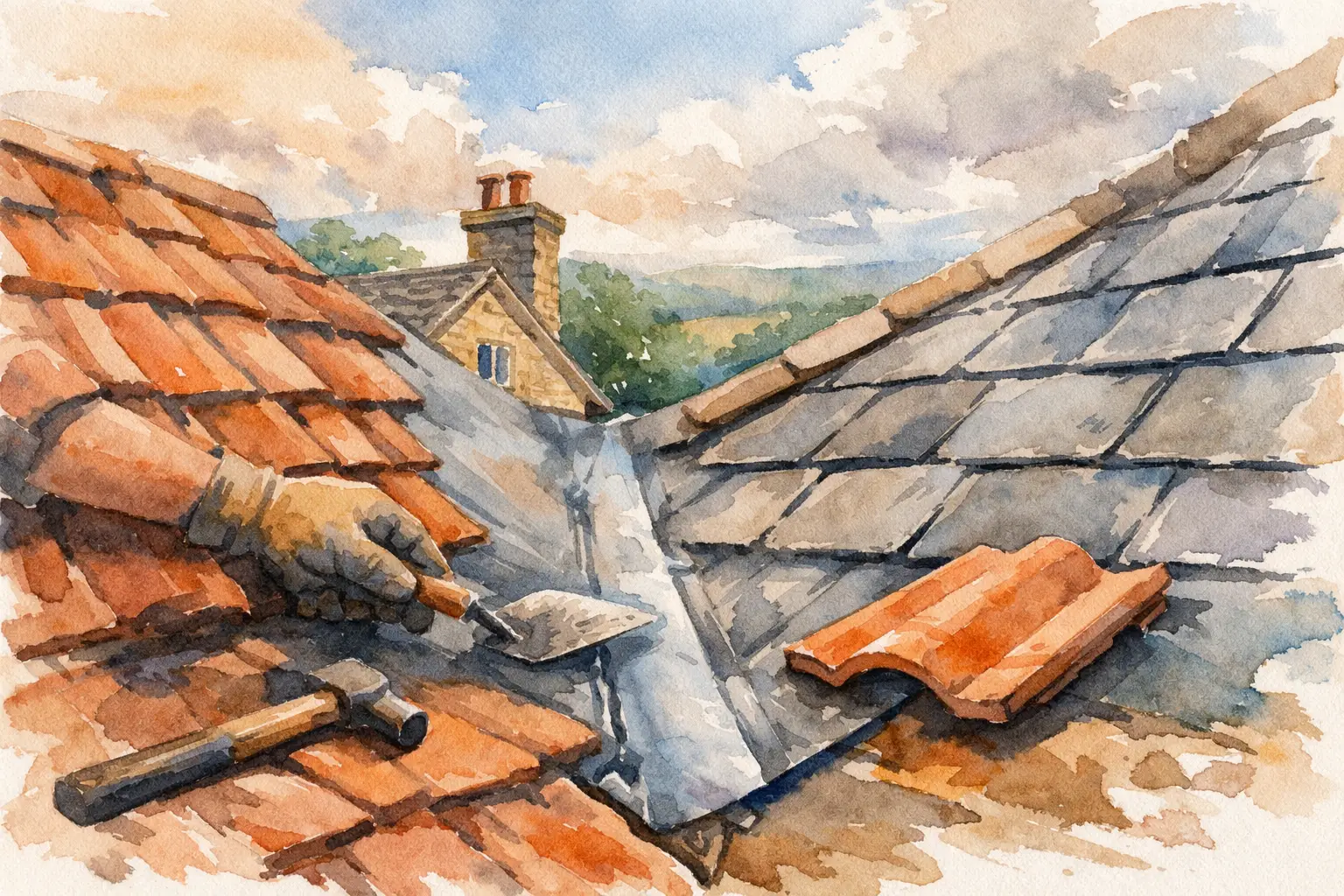
Roof Valley Repair Guide for UK Homeowners
A roof valley can look like a small detail from ground level, but it handles a large volume of rainwater. Where two roof slopes meet, water is channelled into this narrow section and directed towards the gutters. If the valley covering cracks, lifts, blocks or wears through, water can quickly find its way beneath the tiles and into the roof structure. This roof valley repair guide explains what to look for, what a proper repair involves and when it is safer to bring in a professional roofer.
Why roof valleys fail
Roof valleys are under more pressure than most areas of a pitched roof. Rain, moss, leaves and wind-blown debris all collect there, while heavy downpours send a concentrated flow of water through the channel. In Central Scotland, repeated wet weather, frost and strong winds can expose weaknesses that may not be obvious during a dry spell.
Many older roofs have lead valleys, although felt-lined, fibreglass and tile valley systems are also common. Each material has a different lifespan and failure point. Lead can split around fixings or joints, mortar bedding can crack, and older felt valleys can become brittle or tear beneath tiles. A valley may also fail because surrounding slates or tiles have slipped, broken or been poorly repaired in the past.
The key point is that a valley leak is not always visible directly above the damp patch indoors. Water can travel along battens, felt or timbers before appearing on a bedroom ceiling or loft wall. That is why the source needs to be traced carefully rather than simply sealing the first visible gap.
Signs your roof valley needs attention
A visible damp mark on an upper-floor ceiling after heavy rain is one of the clearest warning signs. You may also notice a musty smell in the loft, wet insulation, staining on rafters or daylight around the valley line. Outside, look for slipped tiles, cracked mortar, vegetation collecting in the channel, or a valley that appears uneven from the ground.
Overflowing gutters can sometimes be mistaken for a valley problem, and the two issues can be linked. If leaves and moss block the lower end of the valley, water may back up beneath the roof covering instead of reaching the gutter. Clearing gutters is sensible routine maintenance, but it will not resolve a split lead lining or failed underlay beneath the tiles.
After a storm, it is worth checking the ground around the property for broken tile pieces, lead fragments or loose mortar. Do not climb onto the roof to investigate. Wet tiles, steep pitches and hidden weak spots make roof access hazardous, while walking in the wrong place can crack further tiles and turn a contained repair into a larger one.
Roof valley repair guide: finding the right fix
The right repair depends on the valley material, the age of the roof and the condition of the surrounding covering. A professional inspection should assess more than the obvious surface defect. The roofer should check the tiles or slates beside the valley, the valley lining, fixings, flashing details, underlay and nearby timber where access allows.
Clearing and local tile repairs
Where the valley itself is sound, a repair may be relatively straightforward. Debris can be removed, loose tiles reset and broken units replaced. Missing clips or fixings should be renewed, and any mortar that has failed at the edge of the valley may need to be carefully renewed where that construction method is appropriate.
This is usually the most cost-effective option when the issue is isolated. However, patching is only worthwhile if the lining beneath is intact. Replacing a few tiles over a valley that has already split will only hide the real problem for a short time.
Repairing lead valleys
Lead remains a durable and reliable roofing material when correctly installed. Small cracks or failed joints can sometimes be repaired, particularly where the lead is otherwise in good condition. The work must allow for natural thermal movement. Lead expands and contracts with temperature changes, so rigid fixing or unsuitable sealants often create another failure point.
If the lead is thin, heavily cracked, poorly laid or nearing the end of its service life, replacing the valley is usually the better long-term decision. This involves lifting the adjacent tiles or slates, removing the failed material, preparing the valley correctly and installing new lead with suitable laps, support and detailing. The roof covering is then reinstated securely.
Replacing a felt or fibreglass valley
Older felt valleys can fail beneath the tile line, meaning the damage may not be obvious until water enters the loft. A proper replacement generally requires the tiles on both sides of the valley to be lifted back. The old lining is removed, the timber base is checked for deterioration, and a new valley system is fitted before the tiles are replaced.
This is more involved than applying a surface sealant, but it addresses the waterproof layer that matters. If water has been entering for some time, there may also be damp battens, degraded underlay or rot in the supporting timbers. Those issues should be dealt with during the same work rather than covered over.
Why sealant is rarely a complete answer
Roofing sealant has a place for certain small details, but it is not a dependable cure for most valley failures. A bead of mastic can temporarily slow a leak around a minor joint, yet it cannot restore cracked lead, rotten timber or a damaged lining under the tiles. It may also trap water, conceal deterioration and make a later repair harder.
The same applies to coating an entire valley without identifying the cause of the leak. If water is entering because tiles have slipped or the underlay has failed, a surface coating does not correct the construction beneath. A good repair lets water run freely down the valley while protecting the roof layers below it.
When a repair becomes a replacement
Not every roof valley needs full replacement. A newer valley with one displaced tile may only need a targeted repair, especially if it is caught early. On the other hand, replacement is normally the sensible option where there are repeated leaks, widespread cracking, visible corrosion, deteriorated timber or several previous patch repairs.
There is a cost trade-off. A small repair costs less initially, but repeated call-outs and ongoing internal damage can make it more expensive than renewing the valley properly. If the surrounding roof tiles are ageing or the roof is already due for wider work, replacing the valley at the same time can reduce future disruption and scaffold costs.
For landlords and commercial property owners, it is also worth considering the impact of delayed repairs. A valley leak can damage insulation, plasterboard, electrical fittings and tenant belongings, while persistent moisture can affect timber over a much wider area than the original entry point.
Protecting valleys through routine maintenance
A roof valley does not need constant attention, but regular checks help prevent avoidable failures. Keep gutters clear, particularly after autumn leaf fall and storms. Trim back overhanging branches where practical, as leaves and twigs can form a dam at the bottom of a valley. Moss should be addressed carefully too, as aggressive scraping or pressure washing can damage tiles and force water beneath them.
From the ground, inspect the roof periodically with binoculars if needed. Look for changes rather than trying to diagnose every detail: a new dip in the tile line, sections that appear lifted, debris collecting in one place or damp marks after rain all justify a closer professional assessment.
If you have recently had work completed around a chimney, dormer or roof window, check that the valley remains clear and correctly dressed. Roofing elements work together, and a disturbance to nearby tiles or flashings can alter how water flows across the roof.
Arrange a professional roof inspection
A leaking valley is best dealt with early, before water reaches the roof timbers or finishes inside the property. An experienced roofer can inspect the affected area safely, explain whether a local repair or replacement is appropriate, and provide a clear quote for the work required.
For homeowners in Falkirk and nearby areas, FK Roofing can assess roof valleys alongside related issues such as slipped tiles, damaged flashing, gutters, chimneys and fascias. The practical next step is to arrange an inspection after the first sign of a leak, rather than waiting for the next spell of heavy rain to reveal a bigger problem.